
★ BOTANICAL EXTRACT · GENERALLY SAFE
Saw Palmetto Berry
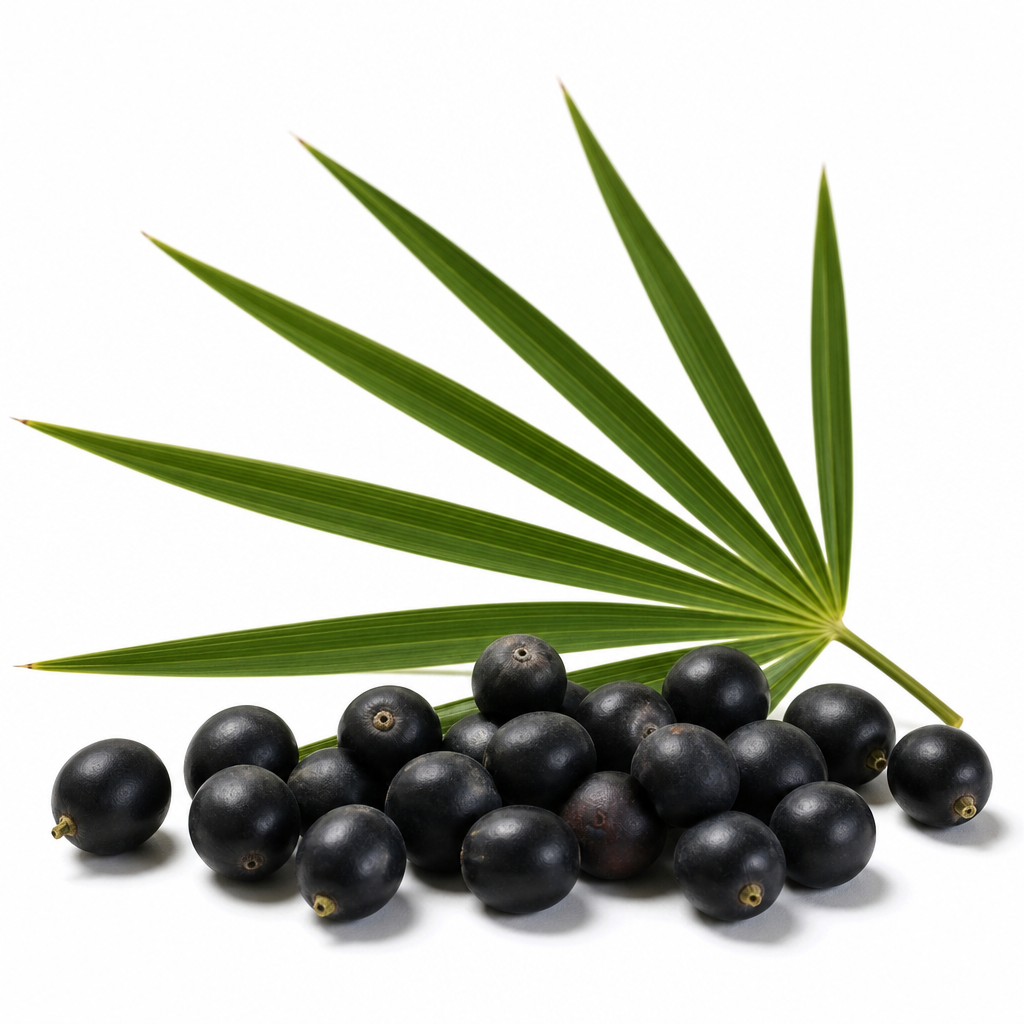
Saw palmetto (Serenoa repens) is a small, slow-growing palm native to the southeastern United States, particularly Florida and the Gulf Coast region. Its dark purple-black berries have been used medicinally for centuries, first by Native American tribes and later adopted into European and American herbal medicine. The berries contain a rich mixture of fatty acids, phytosterols (notably beta-sitosterol), flavonoids, and polysaccharides that collectively contribute to its biological activity.
7.4
Evidence / 10
Moderate
Top benefit
1+
Verified products
What it's proven to support
Evidence confidence for each benefit area, from verified research.
Related ingredients
Frequently formulated and compared with Saw Palmetto Berry.
HOW MUCH
160–320 mg/day of standardized liposterolic extract (85–95% fatty acids)
WHEN
With meals to enhance absorption of fat-soluble compounds
SAFETY
Generally Safe
Shop verified products
View all 1 →
Buyer questions
What exactly is saw palmetto berry and why do people take it as a supplement?
Saw palmetto berry comes from Serenoa repens, a small palm native to Florida and the Gulf Coast, whose dark berries have been used medicinally for centuries by Native American tribes and later incorporated into Western herbal practice. Today it is most commonly used to support prostate health and urinary flow in men, and is also studied for its potential role in DHT inhibition, which connects it to interest in hair loss and hormonal balance. The active constituents are fat-soluble fatty acids and phytosterols concentrated in a liposterolic extract. It is sometimes stacked with other botanicals like [Panax Ginseng Root](/ingredients/panax-ginseng-root) or [Maca Root](/ingredients/maca-root) in men's wellness formulas.
How strong is the clinical evidence behind saw palmetto — does it actually work?
Saw palmetto has one of the more studied evidence profiles among men's botanical supplements, with prostate health support rated at roughly 8.1/10 and urinary flow improvement at 7.6/10 based on accumulated clinical data. Multiple randomized trials and systematic reviews have examined its effects on lower urinary tract symptoms associated with benign prostatic hyperplasia (BPH), with many showing modest but meaningful improvements in urinary flow and symptom scores. Its proposed mechanism — inhibiting 5-alpha reductase to reduce DHT conversion — has reasonable biochemical support, though evidence for hair loss applications (rated around 6.3/10) is less robust than for urinary outcomes. It is worth noting that results across studies are not uniformly positive, and effect sizes tend to be moderate rather than dramatic.
Who is most likely to actually benefit from taking saw palmetto?
Saw palmetto is most commonly used by men over 40 who are experiencing early signs of urinary changes associated with prostate enlargement, such as reduced flow or increased nighttime urination. Men concerned about DHT-related hair thinning also frequently explore it, given its studied activity as a mild 5-alpha reductase inhibitor. It is less commonly used by women, though some practitioners have explored it for hormonal balance support, particularly in conditions involving elevated androgens — though evidence in this population is limited. Individuals already taking prescription medications for BPH or hair loss should consult a healthcare provider before adding saw palmetto, as mechanisms may overlap.
How much saw palmetto should I take daily, and does it matter when I take it?
The most widely studied and clinically referenced dose is 160–320 mg per day of a standardized liposterolic extract, typically standardized to 85–95% fatty acids. Because the active compounds are fat-soluble, saw palmetto is best taken with a meal containing dietary fat to support absorption — taking it on an empty stomach may reduce bioavailability. Some protocols split the dose into two 160 mg servings taken with separate meals rather than a single daily dose. Softgel capsules containing the liposterolic extract are generally considered the most bioavailable form compared to powders or non-standardized tinctures.
Are there any safety concerns or drug interactions I should know about before taking saw palmetto?
Saw palmetto is generally considered well-tolerated at standard doses, with the most commonly reported side effects being mild gastrointestinal discomfort, nausea, or headache, usually associated with taking it without food. Because it may influence androgen metabolism through 5-alpha reductase inhibition, individuals taking hormonal medications, finasteride, dutasteride, or testosterone therapies should consult a physician before use, as effects may be additive or interfere with treatment monitoring. There is also a theoretical concern around anticoagulant interactions — some case reports have suggested saw palmetto may affect platelet aggregation, so caution is warranted for those on blood thinners like warfarin. Pregnant or breastfeeding individuals should avoid it due to its hormonal activity, and it should not be used as a substitute for medical evaluation of urinary symptoms.
How does saw palmetto compare to horny goat weed — are they used for the same things?
Saw palmetto and [Horny Goat Weed (Epimedium)](/ingredients/horny-goat-weed-epimedium) target different primary mechanisms and are not direct substitutes for each other. Saw palmetto is primarily studied for prostate health and urinary flow support through DHT inhibition, while horny goat weed is more associated with circulation, libido, and PDE5 inhibition via its active compound icariin. They are sometimes combined in men's wellness stacks because their mechanisms are complementary rather than overlapping — saw palmetto addressing hormonal and prostate-related concerns while horny goat weed addresses vascular and libido-related ones. If you are exploring a multi-ingredient men's vitality formula that includes horny goat weed alongside other botanicals, the [OPA Horny Goat Weed Capsules](/products/opa-horny-goat-weed-libido-circulation) combines it with Maca and Panax Ginseng, though saw palmetto is not a primary ingredient in that product.
Ready to compare Saw Palmetto Berry products?
1 verified products, scored ingredients, real research.