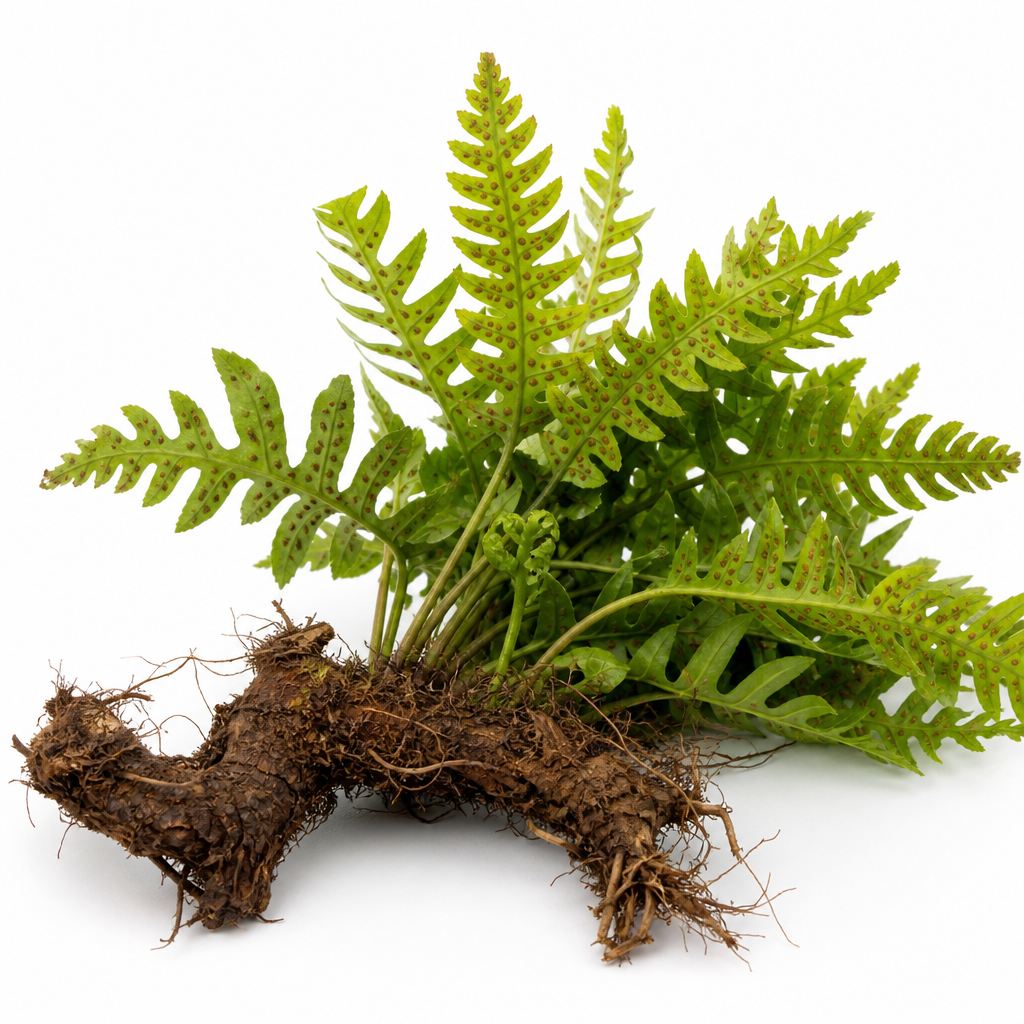
I keep seeing Polypodium vulgare on supplement labels — what actually is it and what do people take it for?
Polypodium vulgare, also known as Common Polypody or Wall Fern, is a perennial fern whose rhizome (underground stem) is harvested for its bioactive compounds, particularly ecdysteroids like ecdysone and phytoecdysteroids, along with flavonoids and polyphenols. It is most commonly used in supplements and topical formulations aimed at supporting skin pigmentation, UV photoprotection, and antioxidant defense, and has also been studied for potential hair follicle health and mild anabolic support. You may see it listed as Polypodium vulgare extract (PVE), Rock Brake, or Adder's Fern on ingredient panels. Related botanicals with overlapping antioxidant interest include [green tea](/ingredients/green-tea) and [marine polysaccharide complex](/ingredients/marine-polysaccharide-complex).
Is there actual clinical research behind Polypodium vulgare, or is it mostly anecdotal?
Polypodium vulgare has a reasonably solid body of clinical and preclinical research, particularly in the areas of skin pigmentation modulation and UV photoprotection, where evidence scores sit around 7.2–7.8 out of 10 based on available human and in vitro studies. Its ecdysteroid content has been studied for antioxidant activity and mild anti-inflammatory effects, with moderate supporting evidence (scores in the 6.1–6.8 range), while its use for hair follicle health and anabolic support is more preliminary (scores of 5.7–6.4). Most of the strongest evidence comes from dermatological research, particularly studies examining its role in melanosome transfer and photoprotection when taken orally or applied topically. As with many botanical extracts, larger randomized controlled trials are still needed to confirm many of its proposed benefits.
Who is most likely to actually benefit from taking a Polypodium vulgare supplement?
People most likely to benefit from Polypodium vulgare are those with concerns about uneven skin pigmentation, sun-related skin stress, or those seeking antioxidant support for skin exposed to regular UV radiation — it has been studied in the context of conditions like melasma and vitiligo, though it is not a treatment for these conditions. Individuals interested in hair follicle health or those looking for a botanical with mild ecdysteroid-mediated support may also find it relevant, though evidence in these areas is less robust. It is used in both oral supplement and topical formulations, so the ideal user depends on whether the goal is systemic or localized support. Those interested in complementary adaptogens for broader wellness may also want to explore [Panax Ginseng Root](/ingredients/panax-ginseng-root) or [Maca Root](/ingredients/maca-root).
How much Polypodium vulgare should I take daily, and does it matter when I take it?
The commonly studied oral dose range for Polypodium vulgare extract is 240–480 mg per day, typically as a standardized extract taken with meals to improve absorption of its fat-soluble ecdysteroid compounds. Taking it alongside a meal that contains some dietary fat may meaningfully enhance bioavailability, since ecdysteroids are partially lipophilic. Topical formulations vary widely in concentration and are not directly comparable to oral dosing. As always, following the specific product's label guidance is important, as standardization levels (e.g., percentage of ecdysteroids) can differ significantly between products.
Are there any safety concerns, drug interactions, or people who should avoid Polypodium vulgare?
Polypodium vulgare is generally considered well-tolerated at typical supplemental doses, with no major adverse effects reported in clinical studies at the 240–480 mg/day range, though long-term safety data in humans remains limited. Because it contains ecdysteroids — compounds with mild hormone-like activity — individuals with hormone-sensitive conditions or those taking hormonal medications should consult a healthcare provider before use. There is currently limited data on interactions with prescription drugs, immunosuppressants, or anticoagulants, so caution is warranted in those populations. Pregnant or breastfeeding individuals should avoid use due to insufficient safety data, and anyone with fern allergies should exercise caution given its botanical origin.
How does Polypodium vulgare compare to Horny Goat Weed — are they used for similar things?
Polypodium vulgare and [Horny Goat Weed (Epimedium)](/ingredients/horny-goat-weed-epimedium) are quite different in their primary applications despite both being botanical extracts with bioactive phytochemicals. Polypodium vulgare is primarily studied for skin pigmentation support, UV photoprotection, and antioxidant activity via its ecdysteroid and flavonoid content, while Horny Goat Weed is best known for its icariin content and its use in supporting circulation, libido, and male vitality. The two share some overlap in antioxidant and mild anabolic interest, but they are not interchangeable for their core uses. If you are specifically interested in a men's vitality formula that includes Horny Goat Weed alongside complementary botanicals, the [OPA Horny Goat Weed Capsules](/products/opa-horny-goat-weed-libido-circulation) combines it with Maca and Panax Ginseng for broader support.